[Dumbbell training contains] a great quantity of exercise in a handful of minutes.
– Benjamin Franklin
For building sheer power, stamina and coordination, there’s nothing to beat dumbbell training.
– Doug Hepburn
Strong, athletic body and real-world strength—from dumbbell curls, flies, and triceps extensions?
No. From classical dumbbell lifting, from the floor to overhead. And don’t take my word for it—listen to what the legends of the Iron Game say about the benefits of dumbbell lifting done right.
Dumbbell Lifting and Health
Aside from the pure-strength exercises, dumbbells are useful for enhancing overall fitness. They’re especially beneficial for older athletes who have accumulated a host of injuries over the years and may have had surgery on one or more joints. Using light-to-moderate dumbbells for higher reps will feed blood to the joints while strengthening the muscles without aggravating the joints. And even if you haven’t had surgery, switching to a dumbbell routine for a short period is a smart idea if you’ve been pounding your joints with heavy weights and low reps for a long time. Using dumbbells for higher reps will give your joints a much needed rest, and when you go back to a pure-strength routine, they’ll be better prepared for the work ahead.
– Bill Starr, “Dumbbell Training”
One-Arm Lifts and the Physique
“It’s the Lifts, Not The Body Parts”, says the title of an article by Greg Pickett in one of the old issues of Kubik’s The Dinosaur Files.
Pavel notes in Enter the Kettlebell (2006), in the chapter dedicated to the kettlebell military press:
It is no coincidence that since overhead presses have fallen out of favor, manly Farnese Hercules torsos with powerful shoulders and midsections have given way to small, feminine waists and large pecs. What a shame, because if you work your overhead presses hard, you will hardly need to do anything else for your upper body.
…and in the original Russian Kettlebell Challenge (2001):
The result will be a physique built more along the lines of Laurent Delvaux’s statue Hercules: broad shoulders with just a hint of pecs, back muscles standing out in bold relief, wiry arms, rugged forearms, a cut-up midsection, and strong legs, without a hint of squat-induced chafing.
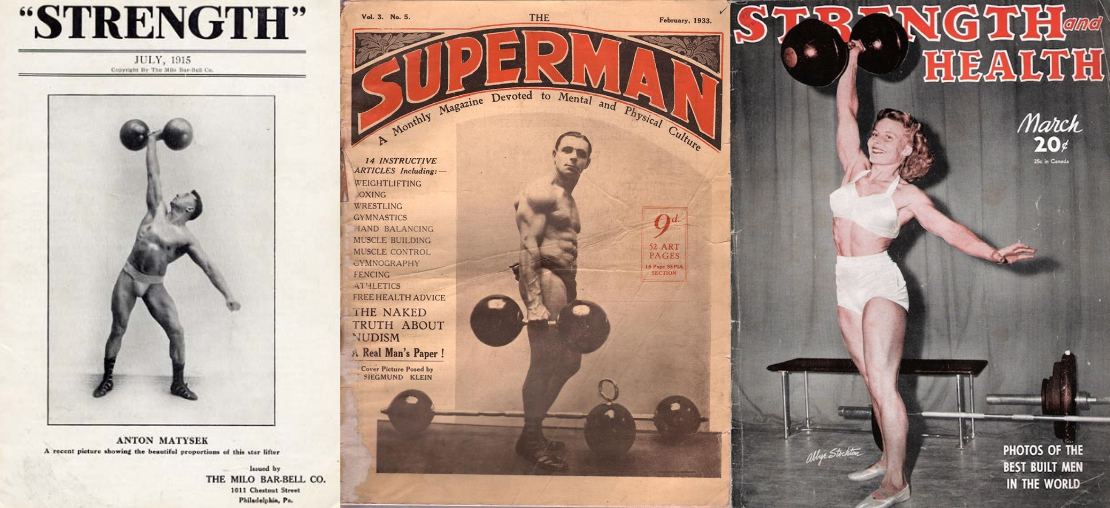
The same, of course, applies to dumbbells and one-arm barbell lifts:
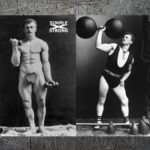
The old one-arm lifts like the Swing, Snatch and One-Handed Clean and Jerk with dumbbells disappeared from competition forever, and with it a certain type of physique characterised by powerfully developed side waist muscles. It cannot be denied that one-arm lifts hit and used different muscles than the two-handed alternatives, but the sport’s leaders made their decision and would never go back to the interesting and more technically difficult lifts of the old-timers.
– Alan Radley, Illustrated History of Physical Culture, 2001
The one-hand events were unfortunately discontinued after the 1924 Paris Olympics.
Although the pair of two-handed lifts currently performed in Olympic-lift competition have proven their popularity over the years, they are by no means the only set that could be used with equal – or possibly even greater – success. The same type of lifts – Snatch, and Clean & Jerk, respectively – when performed with one hand rather than with two – call upon general bodily strength to the same degree as when using two hands, and in addition require greater control, agility, grace and balance.
Too, one-arm overhead lifts of all kinds bring into play and develop the muscles of the side-waist (external or oblique muscles) to a far greater extent than do lifts made with two arms acting together, since the latter require no side-bending at the waist. Some of the greatest professional strongmen on record have been capable exponents of one-arm overhead lifting: Sandow, Cyr, “Apollon,” Hackenschmidt, Lurich, Rolandow, all three Saxons, Edward Aston, Charles Rigoulot, to name only a few.
– David Willoughby, “The One Hand Snatch: An Ideal Lift for Strength & Dexterity”, 1981
Dumbbell Lifting Done Right? Wait no more.
CLICK HERE and Enter the Dumbbell!
Limited-time offer: $99 (regularly $149) through Thursday, December 18.
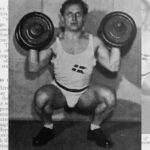
The use of dumbbells for building great power in the arms and shoulders is unsurpassed. And a wonderful byproduct stemming from this use is the added strength of torso and thigh. In dumbbell exercise, the arms are entirely on their own. They work separately as do he muscles of the shoulders and back… that is each group of muscles on each side of the body work independently. In lifting a barbell, they work in concert. Just as an experiment, try the following. Say your top press is 180 pounds with a barbell. Try cleaning and pressing two 90 pound dumbbells… see how far you get them away from the shoulders. Or try it with a training partner for a bet and be sure your money is safe… I have never once seen a weightlifter or bodybuilder equal his barbell press poundage with an equal dumbbell weight.
– Charles A. Smith, “The Two Dumbbell Clean & Press”, Muscle Power, 1952
For the heck of it, load up a heavy dumbbell to a poundage you can just about squeeze seven reps out of in fairly strict military pressing style. With each hand, run through six sets of these seven reps, finishing the six sets, even though you are unable to make seven reps! Then next day, just see how stiff you are, and not only in the triceps, biceps and deltoids, but in the forearms, trapezius, oblique muscles, hips, upper thighs and lumbar region. Dumbbell lifting supplies an almost complete schedule in itself, for every major muscle group. To heighten the effect on the upper back and shoulder girdle, lower back and thighs, clean the dumbbell for every press. After you have recovered from the effects of this workout, use TWO dumbbells instead of one, cleaning them to the shoulders for each press you make. This experiment, more clearly than any explanation I can give, will illustrate the tremendous effectiveness of the two dumbbell clean and press.
– Charles A. Smith &, “Dumbbell Training Builds Lifting Power”, 1953
In exactly the opposite manner to how exercise machines ease and rob the work of a similar barbell move, dumbbells call for even more total bodily involvement than a long bar. Where machines isolate, dumbbells, on the other hand, require extreme control, utilization of many stabilizing muscles, coordination between muscle groups, and total concentration. They have a longer range of motion than barbells or machines, and bombard deep-lying muscle fibers from many different angles.
– John McKean, “Barbells Up, Dumbbells Down Part 1 – Dumbbell Training”, usawa.com
Lift Dumbbells to Improve Your Barbell and Kettlebell Lifts
The most singular thing to me why French Canadian athletes retain the affection for separate dumb bell lifting, even up to the present time. They are more awkward to handle than a bar bell and require greater effort to raise overhead. Probably it is this practice which makes them so efficient they come to handle bad bells, which it later did for Cyr.
– George F. Jowett, The Strongest Man that Ever Lived, 1927
The same applies to kettlebells – dumbbell lifts can serve as a “specialized variety” for kettlebells and vice versa.
Here is an athlete [Doug Hepburn] who has all the strength qualities of the old timers rolled into one. No one has pressed more, or put more weight overhead than he has, pressed more with dumbbells one or two hands, bench pressed or squatted or curled or crucifixed more weight – and Doug tells me he owes much of his incredible power to dumbbell training! It is this training that laid the basics of his present strength. It is this training that has enabled him to become a threat to the best Olympic lifters in the world and increase his total by over 130 pounds in a single year. For dumbbell work gave him the basic power to make rapid gains in snatching and cleaning, on he started working to increase his quick lifts.
– Charles A. Smith &, “Dumbbell Training Builds Lifting Power”, 1953
Dumbbell Training for Fighters
Many authorities of yesterday (and today!) recommended just light dumbbell training – weight-lifting was supposed to make you slow. Opposite to the prejudices of that time (and today’s time!), Thomas Inch recommended bodyweight drills and dumbbell and barbell exercises.
Inch recommends limiting the barbell/dumbbell set to 100 lb:
“…then you won’t be led into ‘trying your strength,’ for the means to do so won’t lie ready to your hand. My idea is to describe and recommend a very few of the forty-two known weight-lifting movements, to be performed once a day with the number of repetitions advised, always with a very light weight so there can never be the least danger of the work interfering with your speed of the movement.
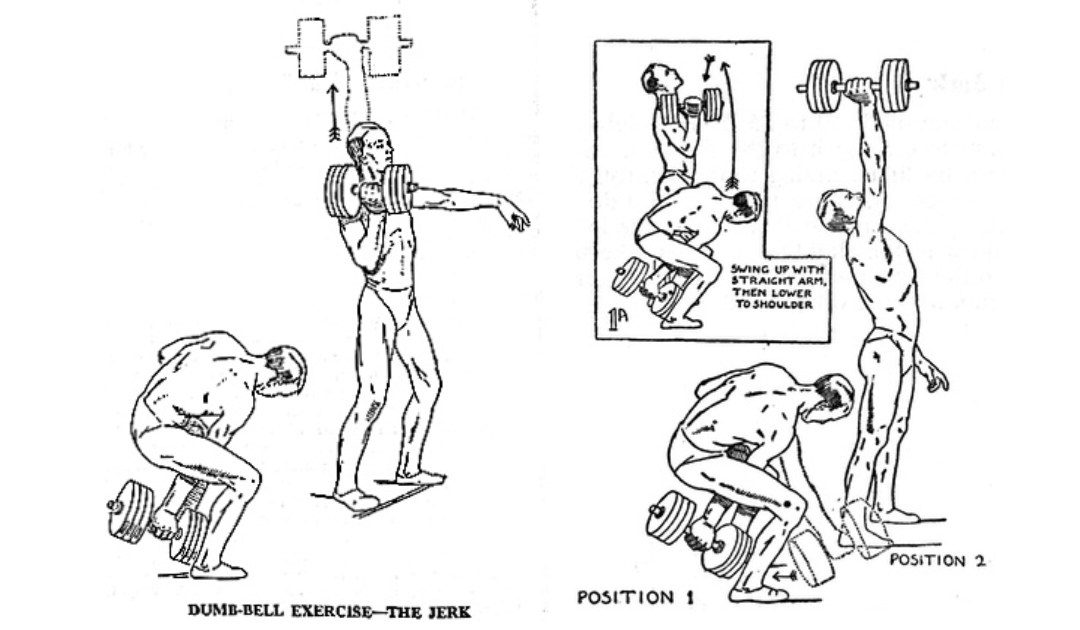
His comprehensive Spalding’s Book on Boxing and Physical Culture features two dumbbell exercises, one pull, one push: dumbbell Swing and dumbbell Jerk (as it is called in the book, but it is actually a push press). Interestingly, Inch prescribes relatively heavy starting weights (40 lb. for swing, 40 to 55 lb. for push press), and low reps – up to 5. Inch obviously knew very well that the boxers are combat athletes who lift weights as part of their general physical preparation – they are not lifters trying to break weight-lifting records. Also, as we know, power is best developed with weights between 1/3-2/3 of your 1RM.
Some high-level coaches, such as renowned boxing coach Steve Baccari, extensively use dumbbells in strength training for combat sports. Steve is very fond of Thomas Inch’s dumbbell minimum for boxers. When I discussed the program with him, he wrote me:
I used that with a large group of fighters , with very good results. In my opinion when it comes to strength training, their’s nothing new under the sun… Old school, is the best school!
Steve’s other favorite dumbbell exercises are get-Ups, goblet Squats, and pullovers.
One of the biggest proponents of dumbbell training for fighters is Ross Enemait. Where Brooks Kubik emphasized heavy low-rep pure strength work, Ross took the HIIT road. His Infinity Intensity is one of the few modern resources that cover many old-school dumbbell lifts and their variations.
Lift Dumbbells to Become a Starr
I’m a big fan of dumbbells, both light and heavy. They’re most useful to all serious strength athletes, as well as those who only train for general fitness, and they’re invaluable for rehab. What’s more, for people who train alone, they’re extremely beneficial, since you don’t need a spotter.
…
Keep in mind that any exercise you can do with a barbell you can also do with dumbbells. The only exceptions that I can think of are full cleans and full snatches. I guess you could do them, although I’ve never seen it.
…
It’s a smart idea to have some dumbbells at home even if you train at a commercial gym. On your non-gym days you can hit a couple of areas that might benefit from extra work.
…
So, if you haven’t been using dumbbells, give them a try. And if you happen to be in the mood to change your entire program, dumbbell training may be the way to go.
– Bill Starr, “Dumbbell Training”
-
Sale!

GGP: The Great Gama Protocol [ONLINE COURSE]
Original price was: $149.$99Current price is: $99. -
Sale!
THE FORGE: Full Year’s Transformation Program [ONLINE COURSE]
Original price was: $499.$249Current price is: $249. -
60 Minutes Online Private Lesson
$99 -

Hard Style Dumbbell Swing [VIDEO+MANUAL]
$0 -

StrongFirst RESILIENT—Chelmsford, United Kingdom—March 21-22, 2026
$795 -
Sale!
SFB StrongFirst Bodyweight Instructor Certification – Prague, Czechia, April 18-19, 2026
Price range: $1095 through $1295 -
![Enter the Dumbbell! [ONLINE COURSE]](https://simplexstrong.com/wp-content/uploads/2025/12/strongfirst-enter-the-dumbbell-400x400.jpg)
Enter the Dumbbell! [ONLINE COURSE]
$149 -
Sale!
SFG II StrongFirst Kettlebell Instructor Certification – Prague, Czechia, October 10-11, 2026
Price range: $895 through $1295