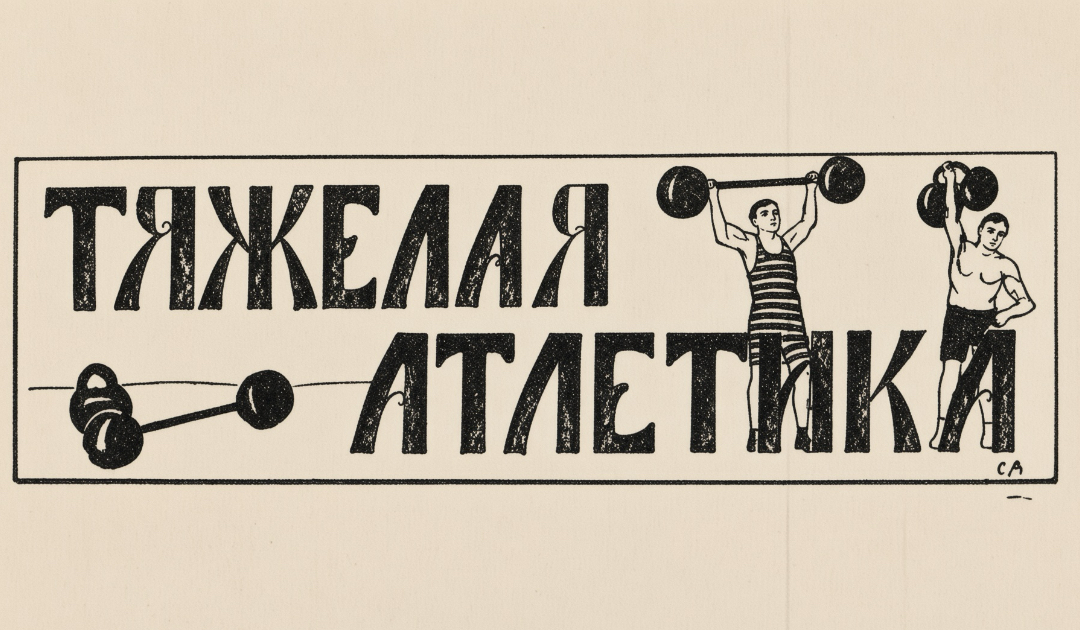
This remarkable serialized article by Ivan “Uncle Vanya” Lebedev appeared in Russian Sport in 1910. It is a rare early example of principle-based strength-training advice: not simply a catalog of exercises, but practical rules governing tension and relaxation, loading, frequency, technique, breathing, recovery, conditioning, and balanced whole-body development.
More than a century of coaching experience and sports science has naturally changed some of the details, and a few recommendations unmistakably belong to their time. Yet what is striking is how much of Lebedev’s advice still rings true: train both sides, distinguish between heavy, medium, and light work, respect recovery, practice correct technique for repetitions, build strong legs, and combine strength training with general physical preparation.
A note on the original title is important. The Russian word girevik is easily misunderstood today as simply meaning “kettlebell lifter.” In Lebedev’s time, it meant something broader—essentially a weightlifter or strength athlete. This is obvious from the article itself: Lebedev discusses barbells, kettlebells, heavy “bulldog” dumbbells, light dumbbells, and scale weights. This is not simply a kettlebell program in the modern sense, but advice for the aspiring all-round lifter. At the same time, it is equally clear how central the kettlebell was to the training culture of old-time strongmen—and strongwomen.
Read it not only as an Iron Game historian, but also as a coach. Which principles have survived more than a hundred years? Which would you modify today—and why?
Please add your comments and observations.
Advice to Beginning Kettlebell Lifters
I. V. Lebedev
1. One should never tense the muscles when approaching a barbell [shtanga; штанга] or kettlebell [girya; гиря]; on the contrary, the muscles should be completely relaxed.
2. The bar [grif; гриф] of the barbell or the handle of the kettlebell should not be gripped tightly with the fingers.
3. When lowering a weight, lower it smoothly and calmly, without tensing the muscles.
4. When preparing to lift, one should not remain bent over the barbell for a long time.
5. Every one-arm exercise should be performed alternately with the right and left arms, striving to lift the same weight with each arm.
6. One should train with heavy weights—defined for each trainee as weights beginning 30 Russian pounds [about 12 kg] below his maximum—no more than 3 times a week. One should train with medium and light weights 2 times a week. Two days a week—complete rest.
7. One should exercise either completely naked or in short, light trousers (trunks).
8. After training with weights, one should engage in running (slow, for endurance) and jumping.
9. During training, particular attention should be paid to exercises with separate weights [razdel’nyi ves; раздельный вес]—bulldog dumbbells [bul’dogi; бульдоги] or scale-weight kettlebells [vesovye giri; весовые гири]—lifted simultaneously or alternately. Chiefly—to the press [vyzhimanie; выжимание].
10. During the initial period of training, beginners should breathe through the mouth, because beginners ordinarily close their mouths and hold their breath entirely. After one or two months, one should become accustomed to breathing through the nose.
11: After training with weights and running, one should allow the perspiration to dry from the body and then either take a shower or thoroughly wipe the entire body with water. At first, begin with water at room temperature and gradually accustom oneself to cold water.
12. About 15 minutes after washing, one should drink one or two glasses of tea with sugar or warm milk and eat something nourishing.
13. The most convenient time for training with heavy kettlebells is the evening, from 7 o’clock onward. Training should begin no sooner than an hour and a half after dinner and should end 2–3 hours before sleep.
14. Particular attention should be paid to the two-handed behind-the-neck press; the barbell should be lowered as far as possible.
15. Training with each weight should be performed “for repetitions” [na razy; на разы], while maintaining correct breathing.
16. During the two-handed Press, Jerk [tolkanie; толкание], and Snatch [vyryvanie; вырывание], as well as during the one-handed Snatch, care should be taken to ensure that, at the completion of the lift, the barbell is directly above the head rather than in front of it.
17. Regarding the two-handed Jerk, it should be explained that the Jerk is a lift performed with leg drive [shvunkovoe dvizhenie; швунковое движение] and requires, chiefly, rapid execution. Therefore, after bringing the barbell to the chest, one should drive it rapidly to straight arms overhead, simultaneously jumping the right foot forward and quickly placing the left foot back. This is the easiest style of the Jerk. The same split is used in the one-handed Jerk, except that the leg on the lifting side is brought forward while the other leg remains back.
18. One should not forget that an athlete requires strong and powerful legs. Therefore—frequently perform squats on the toes with the barbell held behind the body.
19. The following collection of weights is quite sufficient for any athletic club: 1) a plate-loaded barbell [razbornaya shtanga; разборная штанга] weighing up to 7 poods [about 115 kg]; 2) two two-pood kettlebells [about 33 kg each]; 3) a pair of bulldog dumbbells weighing from 40 to 80 Russian pounds [about 16–33 kg]; 4) pairs of dumbbells [ganteli; гантели] weighing 3, 5, 7, 10, 12, 15, and 20 Russian pounds [about 1, 2, 3, 4, 5, 6, and 8 kg, respectively]. Any metalworker can make a plate-loaded barbell. The bar (shaft)—30–40 Russian pounds [about 12–16 kg]; the plates [shaiby; шайбы] (“pancakes” [bliny; блины])—5, 10, and 20 Russian pounds each [about 2, 4, and 8 kg, respectively]. The length of the bar—2¾ arshins [about 2 m], and its thickness about ¾ vershok [about 3 cm].
20. During the Press, Snatch, or Overhead Swing [vybrasyvanie; выбрасывание] with a scale-weight kettlebell held “bottoms-up” [vverkh dnom; вверх дном], the kettlebell should be grasped at the middle of the handle.
21. When performing a two-stage continental clean to the chest [podnimanie shtangi na grud’ v dva tempa; поднимание штанги на грудь в два темпа], one should first rest the barbell on the abdomen against the protruding belts (the legs must not be bent at this point), and then heave it to the chest by rapidly bending and straightening the legs. While the barbell rests on the abdomen, one should not lean the torso backward.
22. During the two-handed Jerk, after the split [vypad; выпад], one should bring the rear foot up to the front foot while keeping the barbell fixed overhead.
23. During the two-handed Snatch, one should not take an excessively deep grip on the bar.
24. For the Overhead Swing or Snatch with a scale-weight kettlebell, place it in front of the body so that its handle is perpendicular to the line running along the floor between the lifter’s feet.
25. When lifting scale-weight kettlebells for repetitions, either singly or as separate weights, they should be lowered to the shoulders handle-first.
26. The squat [prisedanie; приседание] with the barbell across the upper back should be performed on the toes and as deeply as possible. During the Biceps Curl [prityagivanie na bitseps; притягивание на бицепс] with one or two hands, one should not lean the torso backward.
27. During every two-handed barbell lift, the distance between the heels should be slightly more than ¼ arshin [about 18 cm], except during the military Press [vyzhimanie v soldatskoi stoike; выжимание в солдатской стойке], when the heels must be together.
– Ivan V. Lebedev, “Advice to Beginning Weight-Lifters,” Russian Sport, 1910.
One final note: Lebedev later revised and refined some of these recommendations in his books Heavy Athletics (1916) and Training with Heavy Kettlebells (1928), reflecting his growing experience as a lifter, coach, and author.
We will be translating and publishing material from these books in the future, so make sure to subscribe to the SIMPLEXSTRONG newsletter if you don’t want to miss the next installment.

![Enter the Dumbbell! [ONLINE COURSE]](https://simplexstrong.com/wp-content/uploads/2025/12/strongfirst-enter-the-dumbbell-400x400.jpg)




Praise The LORD for you, Pavel! It is so nice to read this advice today from America. I appreciate you greatly for your efforts in translating, along with your prompting questions. What stands out to me is the focus on the Behind the Neck Press. Also, the matter-of-factness that no matter the implement weightlifting means press, jerk, snatch, clean, and squat. Of course the funny advice to train naked, too. Much appreciated, Ricky.
Thank you, Ricky! One of my buddies, Jiří Tkadlčík, 2x World’s Strongest Man (105 kg), is a huge fan of the behind-the-neck press—and so were many old-timers. The press, push press, jerk, snatch, overhead swing, and later some squats made up 80% of old-time strongmen’s lifting.