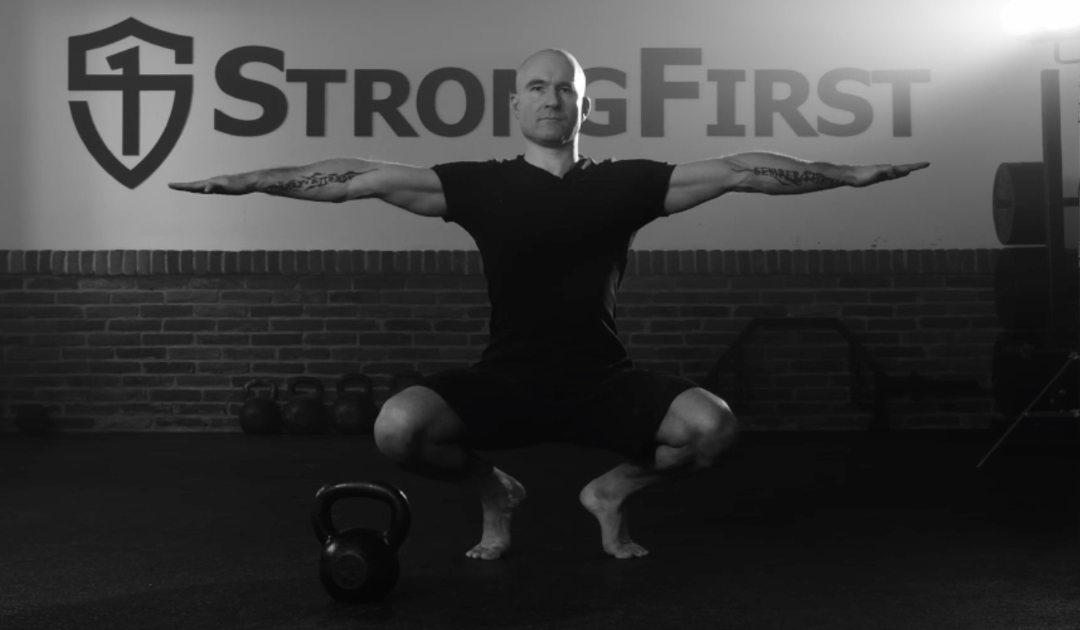
Heels up. Knees forward. Squat deep.
The forgotten deep knee bend – from old-time strongmen to modern kettlebell training.
Long before leg presses and elaborate lower-body training programs, old-time strongmen built powerful legs with a simple exercise: the deep knee bend. Unlike the conventional flat-footed squat, the traditional deep knee bend is performed on the balls of the feet, with the heels raised, the knees traveling well beyond the toes, and the torso upright.
The benefits? Strong quadriceps, improved ankle and knee mobility, balance, coordination, and greater strength and control in deep knee flexion.
And that old warning about never letting your knees travel past your toes? Forget it. Forward knee travel is a normal part of human movement. The key is to develop the necessary strength, mobility, and tolerance to loading progressively.
What the Old Masters Said
Legendary strongman and wrestler George Hackenschmidt was a great advocate of the deep knee bend. In his 1908 classic The Way to Live in Health and Physical Fitness, he instructed:
Stand erect, heels together, feet turned out. Extend arms right and left from shoulders and sink down, bending the knees outwards and rising on toes, until you are almost squatting on your heels. Return to first position and repeat bend with arms stretched in front. Return and sink again with arms stretched above head.
His verdict?
“One of the best leg exercises in the world.”
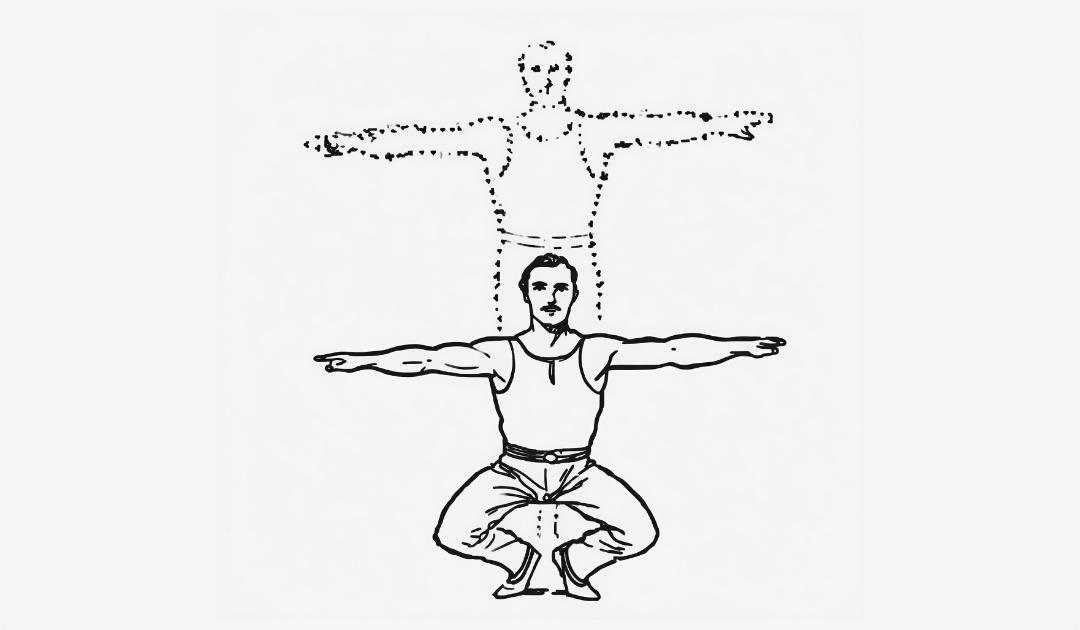
Restored deep knee bend image from George Hackenschmidt’s 1908 classic The Way to Live in Health and Physical Fitness
Another pioneer of the Iron Game, Alan Calvert, offered practical advice on progression in his 1924 classic Super-Strength:
Doing the deep knee bend without weights is an endurance exercise, while doing it with weights is a strength exercise. Just the same, no one should use weights until he can perform the deep knee bend fifty times in succession without weights.
Fifty consecutive repetitions before adding iron. Not a bad standard, even a century later.
High Repetitions for Health, Heavy Weights for Strength
Our formula is simple: low-rep/heavy training for strength, and high-rep/light exercise for health.
Muscles are only part of the equation. Tendons, ligaments, cartilage, and other connective tissues must also be prepared for the demands of strength training.
Steven Low writes in his excellent Overcoming Gravity (2011):
Connective tissues such as tendons, ligaments, and cartilage tend to respond better to higher repetitions because of the increase in blood flow… Utilise not-to-failure training, very light weight, very high repetitions, and a lower number of sets in order to strengthen your connective tissues.
A high-repetition calisthenics program is one of the best options when starting strength training. Thomas Kurz writes in his excellent Science of Sports Training: How to Plan and Control Training for Peak Performance (2016), in the chapter “Preparation for Strength Training”:
The first step to make the connective tissue stronger, without causing muscle soreness, is to improve its blood supply with strength-endurance exercises. In physical therapy, this is accomplished with light resistance that permits doing one hundred repetitions in one set (Hertling and Kessler 1996). Muscular endurance is increased, among other factors, through improvements in local circulation and typically developed with sets of 20 or more repetitions (Wilmore and Costill 1999). At least two sets of exercises for the muscles that are most likely to be overstressed in the athlete’s sport should be done with a minimum of 30 repetitions per set. Good results are also brought about by doing long single sets of 100 to 200 repetitions. In both cases the weight has to make the last few repetitions “burn.”
…
When the athlete is preparing for working with heavy resistance in the future, then the high repetition exercises will constitute the main part of his or her strength workout.
Pavel Tsatsouline confirms this approach and recommends “doing such work after a strength session” as another option.
Our online course, GGP: The Great Gama Protocol, a minimalistic, simple, and time-tested “youth-restoring calisthenics” routine, fits the bill.
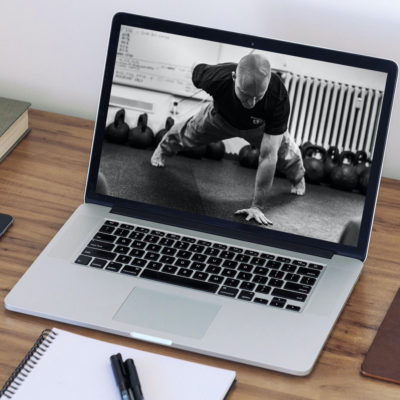
An excerpt from the Kettlebell VIP online course Hack squat module (running time 12:37)
Own the Bottom Position
Start with a comfortable range of motion and gradually work toward thirty, then fifty consecutive repetitions. Do not rush. Pause briefly at the bottom of every repetition. No bouncing, no dropping into the bottom position and relying on momentum to get back up. Descend under control, pause for a second or two at the deepest position you can actively maintain, and rise smoothly.
Keep the knees tracking in the direction of the toes. If you cannot control the bottom position, reduce the depth and gradually earn a deeper squat.
Enter the Kettlebell Hack Squat
Once you have mastered the bodyweight deep knee bend, it is time to add iron. One excellent option is the kettlebell hack squat, a variation of the old-school hack squat popularized by George Hackenschmidt in the early twentieth century.
The kettlebell version retains the essential characteristics of the traditional deep knee bend—raised heels, forward knee travel, and deep knee flexion—but adds external resistance. The result is a demanding, quadriceps-dominant strength exercise that also challenges mobility, balance, and control.
The kettlebell hack squat is demonstrated in our Kettlebell VIP online course and taught hands-on at StrongFirst RESILIENT, our special two-day event dedicated to developing strength, mobility, and resilience.
The old masters had it right. Start with your bodyweight, build up to fifty technically sound repetitions, and then add iron.
The full Kettlebell VIP online course Hack squat module runs 12:37 and covers many old-time strongman variations of the deep knee bend and Hack squat:
- Hackenschmidt’s Deep Knee Bend — 3 Variations
- Hack Squat
- Hack Squat from the Bottom
- Face-the-Wall Hack Squat