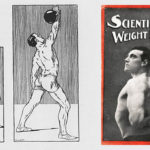
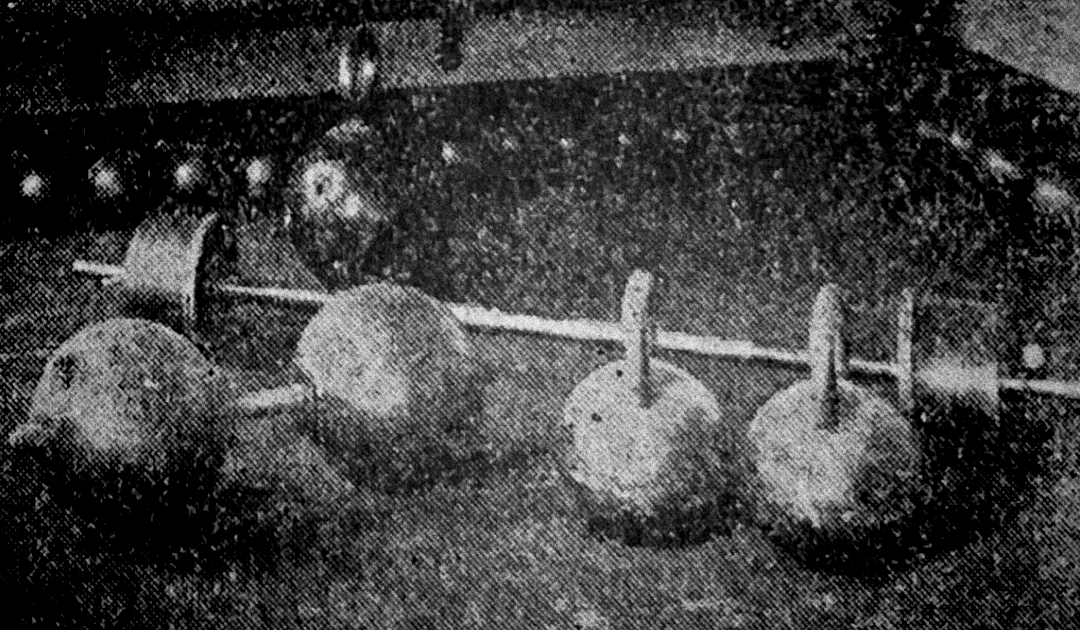
In 1916, Ivan Vladimirovich Lebedev—better known as “Uncle Vanya” (Дядя Ваня)—published Heavy Athletics(Тяжелая атлетика), subtitled A Guide to Developing Your Strength by Exercising with Heavy Weights.
Lebedev, a student of Dr. Vladislav Kraevsky, was an influential coach, writer, and popularizer of pre-revolutionary Russian strength training. His 200-page manual, illustrated with some 300 images, covers training and lifting with barbells, heavy dumbbells, and kettlebells, as well as the history of weightlifting and strength training and biographies of famous strongmen of the era.
The book is an important primary source on the development of Russian physical culture, offering a direct look at how strength training was practiced, taught, and understood before the Soviet era.
A century of strength science and coaching has changed our understanding of several points in Lebedev’s advice. We now recognize the role of the Valsalva maneuver in creating trunk stability under heavy loads, rather than universally advising lifters not to hold their breath. Modern strength practice also makes deliberate use of irradiation and feed-forward tension: muscles that are not the prime movers may be intentionally contracted to increase stability and force production. Likewise, Lebedev’s medical contraindications reflect the terminology and knowledge of his time and should not be treated as current medical guidance.
Other details are specific to the lifting techniques and equipment of his era, and modern coaching may approach them differently. At the same time, much of his broader advice remains strikingly familiar: master technique before handling heavy weights, avoid reckless record attempts, progress through preparation, stay composed under the bar, and remember that training has value beyond setting records.
We have therefore kept Lebedev’s original advice intact rather than “correcting” it to match modern practice. It should be read as a historical primary source—one that shows both how much strength training has changed since 1916 and how much of its fundamental wisdom has remained the same.
Advice for Beginners
My late teacher, Dr. V. F. Kraevsky, would answer those who opposed training with heavy weights¹ because “you might strain yourself” as follows: “If you can lift the weight, you will not strain yourself. And if you cannot lift it, you will not strain yourself either, because you will not lift it.”
That was rather witty, but not entirely correct. Training with heavy weights without knowing the basic principles of weightlifting can indeed cause injury and seriously damage your health. Yet the basic principles of weight training are very simple. Here they are:
- Do not lift weights with abrupt movements—especially, do not yank them off the ground—and you will not strain yourself.
- Do not hold your breath while lifting a weight, or while approaching it.
- Do not unnecessarily tense muscles other than those doing the work. For example, in the two-arm press and jerk,² there is no need to grip the barbell tightly. In any movement with weights, muscular tension is needed only to raise the weight; lower it easily, without any muscular tension.
- Always lift smoothly, without abrupt movements. Even in the jerk, every phase of the movement should be smooth.
- Do not become nervous, either while lifting or before you begin. In other words, do not fear the weight. Convince yourself that you must lift it—that you cannot fail to lift it.
If you learn and follow these rules, weightlifting will not do you the slightest harm and will certainly bring substantial benefits: greater strength, muscular development, and an awareness of your own strength. Anyone can become two or three times as strong, and heavy weights are one of the most powerful means of making a person stronger.
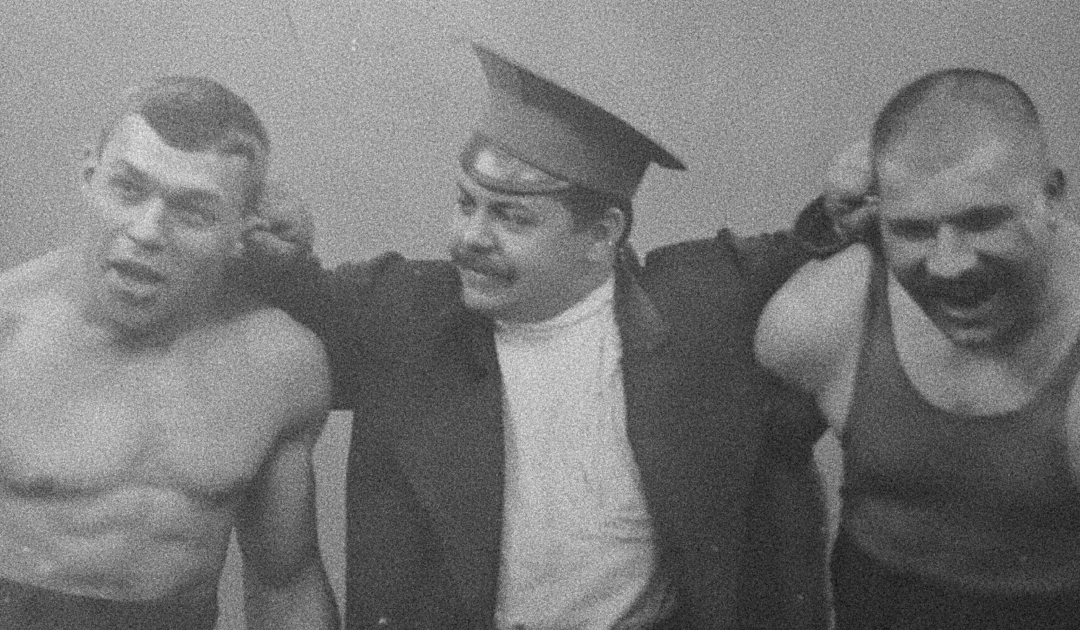
Lebedev “Coaching” Misbehaving Wrestlers Yakovlev and Rusakov
Not everyone can or should train with heavy weights. A heart defect—which is often confused with cardiac neurosis³—a predisposition to hernia, kidney disease, and venereal diseases in their acute stage: these are the unfortunate conditions in which training with heavy weights is strictly out of the question. As for people with a “nervous heart,” I have seen dozens who became entirely healthy after following a sensible programme of exercise that included weight training.
When training with weights, you must distinguish between lifting to set a record and lifting for training. However tempting records may be, pursue them with great caution. Do not attempt records without thorough preparatory training. If a record will not come, do not be discouraged or give up training. After all, nothing in the world will change because you failed to lift another 10 pounds [4.1 kg]⁴—and your training will still benefit you greatly.
Translator’s notes
- Weights — гири (giri). In this period, the Russian term could refer broadly to lifting weights, including barbells, rather than exclusively to kettlebells. Lebedev’s explicit reference to the barbell confirms that broader meaning here.
- Press and jerk — выжимание и толкание. The standard English lifting terms. A press raises the weight overhead without leg drive; a jerk uses leg drive followed by a second knee bend to receive the weight overhead on straight arms. “Every phase” translates все темпы: Lebedev is describing the stages of the lift, not prescribing a slow tempo.
- Cardiac neurosis / “nervous heart” — невроз сердца / нервное сердце. Historical medical expressions, retained without assigning a modern diagnosis. The Russian says that cardiac neurosis was often mistaken for a heart defect. Lebedev’s medical claims and his instructions on breathing and muscular tension are reproduced as historical statements.
- Russian pounds — фунты (funty). The original uses the Russian pound, approximately 0.4095 kg, rather than the modern English pound. Thus, 10 Russian pounds equal approximately 4.1 kg.