This, the last of the old championship four, is a much more difficult feat to some lifters than the two-handed bar-bell, although I believe that Mr. Caswell has lifted more in this lift (and with unequal dumb-bells to boot) than he could manage with the bar-bell.
Different lifters use different methods of pulling in a pair of dumb-bells to the shoulders, and, honestly, since I have seen so many excellent performances with each method, I am somewhat loth to advise.
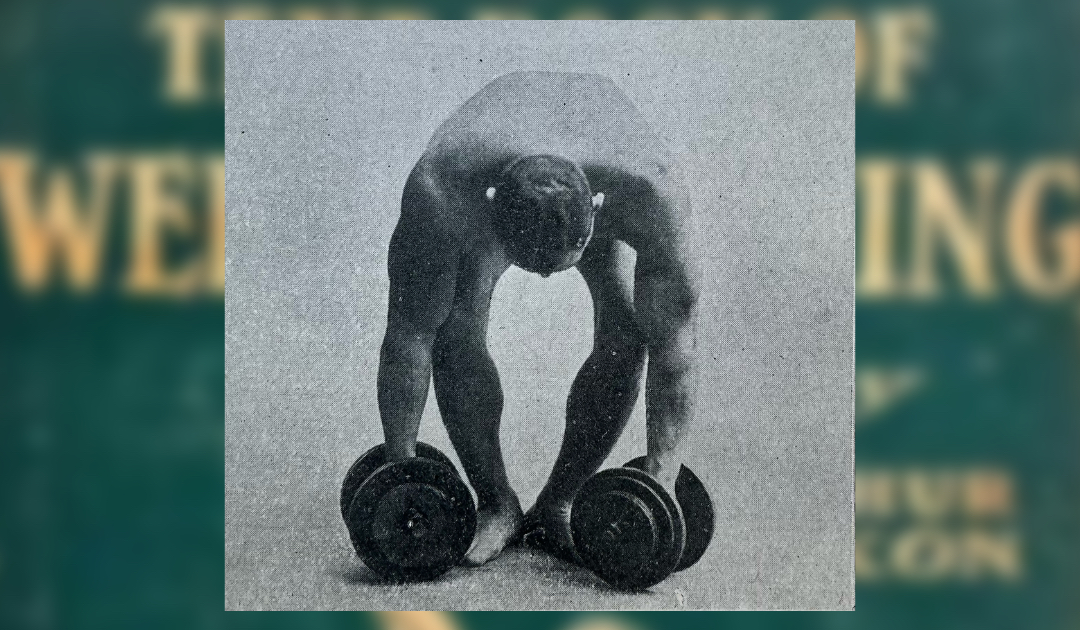
In any event, the best way to commence is to stand with heels together and bells close to the legs. Stoop down, bending at the hips and knees, and grasp the bells firmly close to the front discs or spheres.
At this point you may get them to the shoulders in either of the following styles:—
Pull them up sharply towards the shoulders, with elbows pointing well out, splitting your feet back and forward, and sinking the trunk so as to get the shoulders down to the level with the bells, when by leaning sharply backwards you can exert such a pull as will greatly assist your arms in turning the bells to the shoulder.
This I think the best way, but some weight-lifters rise with the bells hanging at the sides, and then, swinging them first forward and then back, get a good upward momentum towards the shoulders to assist their body dip. The legs must, of course, be split slightly before swinging and again just before the dip.
The shouldered position also varies with different lifters. The majority prefer to have their elbows close at their sides, hands slightly out from the shoulders, and bells turned so that the front spheres or discs approach each other.
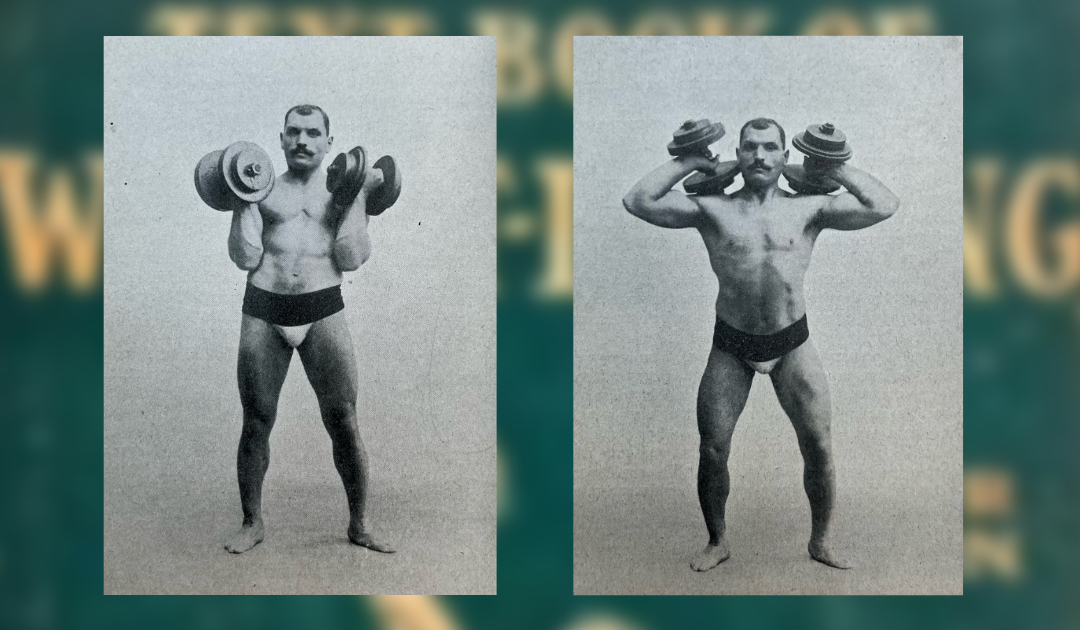
Mr. Inch, however, considers the best position to be one in which the upper arm is nearly parallel with the shoulder and in continuation thereof, with the forearm bent back so that the bells practically rest on the shoulders themselves. In this position he keeps his back straight and jerks from the shoulders, as in the bar-bell lift. He claims this as a discovery, and as one which is distinctly preferable to the older methods.
He is very probably right, but I have not so far tested his method thoroughly, finding that I can still do better in the position to which I am accustomed, as already described.
I have failed to see any advantage in this method, but Mr. Inch has certainly increased his own powers at the lift by the discovery of this, so there may be a good deal in it.
From either shoulder position the dumb-bells should be jerked aloft exactly as is the two-handed bar-bell.
If no restrictions be made about the bells actually resting on the shoulders and supported thereby, a far greater weight can be jerked by pulling them in and resting them on end on the shoulders as shown in illustration. The arms are then thrown straight, and by a slight body dip the correct position of a completed lift is obtained.

Learn the proper fundamentals in my Enter the Dumbbell! online course
25% OFF TILL SATURDAY, AUGUST 8
Original Images Description
- Top: Two Dumb-Bell Lift. First Position.
- Middle left: Two Dumb-Bell Lift. Pulled in (English Style).
- Middle right: Top: Two Dumb-Bell Lift. Pulled in (resting on the shoulders). A good position if there be no restrictions as to contact.
– Arthur Saxon. The Text-Book of Weight-Lifting. London: Health & Strength, 1908.


![Enter the Dumbbell! [ONLINE COURSE]](https://simplexstrong.com/wp-content/uploads/2025/12/strongfirst-enter-the-dumbbell-400x400.jpg)