In 1889, the strongest men in the world met in London for one of history’s most famous strongman challenges. Eugen Sandow faced the legendary Samson in a contest of heavy lifts, support feats, bent bars, broken chains, and brute strength. But the challenge may ultimately have been decided not by who could merely lift the most weight—but by who could get up with it.
In the popular imagination, Eugen Sandow defeated Samson through superior strength alone. But the decisive feat of the famous 1889 Royal Aquarium challenge may have been something much more specific: the get-up.
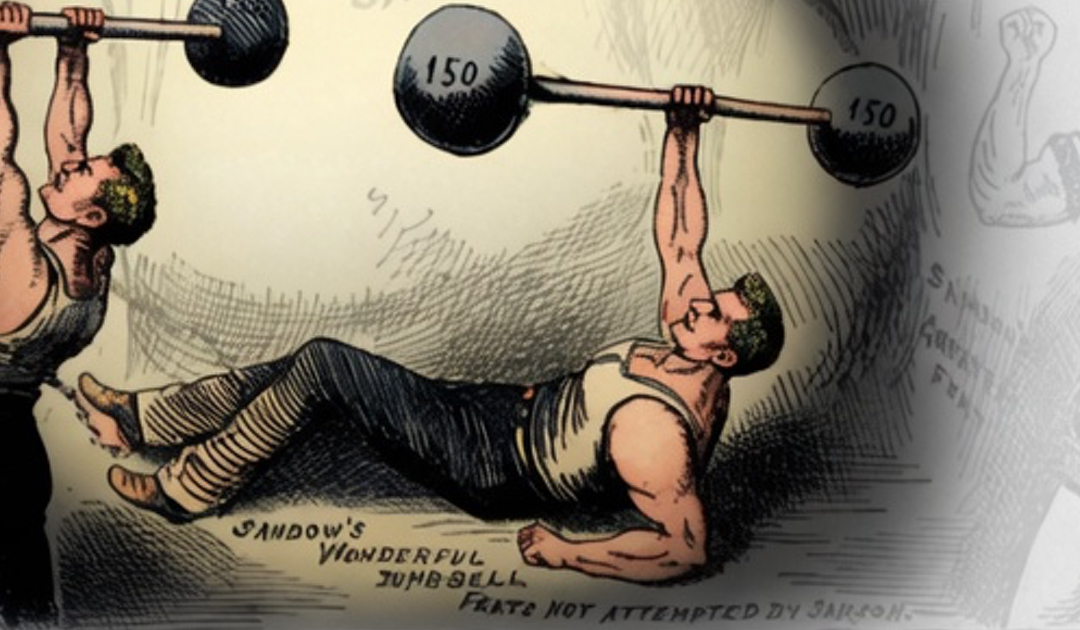
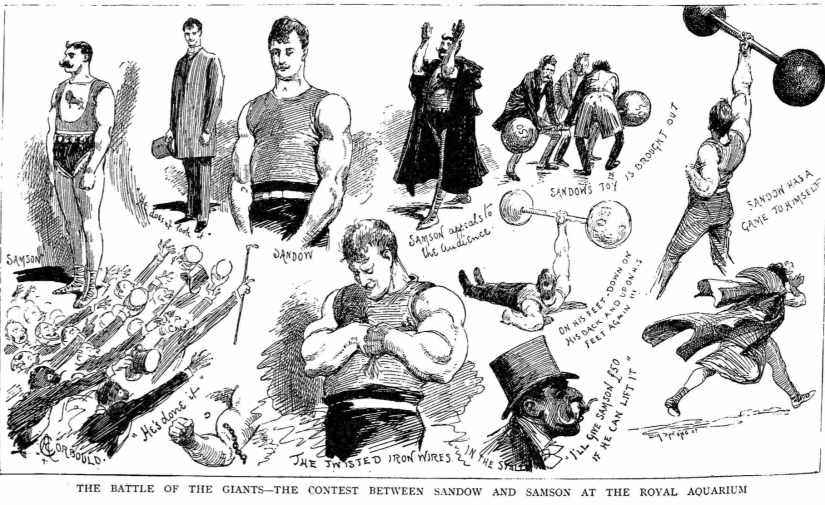
After matching the official challenge lifts and feats of strength, Sandow introduced a movement Samson reportedly did not even attempt. A massive globe dumbbell—described by Sandow as weighing 280 pounds (about 127 kg), though illustrated newspapers depicted it as 300 pounds—was brought onto the stage. Sandow then performed a feat that shocked Victorian audiences. Sandow writes in Strength and How to Obtain It (1897):
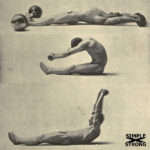
I made the offer that if either he [Samson] or his pupil, Cyclops, could repeat my performance with a dumb-bell which I had at hand, we would declare the result a draw, and he could keep his £1,000. The dumb-bell, which was then brought on to the stage, weighed 280lbs. With one hand I lifted it up, then laid down, and finally stood up with it.”
The image below says:
ON HIS FEET — DOWN ON HIS BACK — AND UPON HIS FEET AGAIN
This was not merely a heavy lift. Strongmen of the era could often support tremendous weights in partial motions, leverage positions, or theatrical displays. But to descend to the floor under control and then rise again with such a weight required something far rarer: total-body integration.
The feat demanded crushing grip strength, shoulder stability, trunk rigidity, mobility, balance, coordination, and the ability to transfer force through the entire body under load.
In modern language, it was essentially a heavy one-arm get-up.
And that may have been exactly why it decided the contest.
Samson’s challenge represented the old world of exhibition strongmanship: bent bars, broken chains, support feats, and staged demonstrations of power. Sandow matched these feats—but then surpassed them by displaying something more athletic, more functional, and arguably more complete. The get-up demonstrated not only strength, but mastery of the body under load.
The Illustrated Police News itself emphasized this point. Beneath the image of the dumbbell feat appeared the caption:
“Sandow’s wonderful dumb-bell feats not attempted by Samson.”
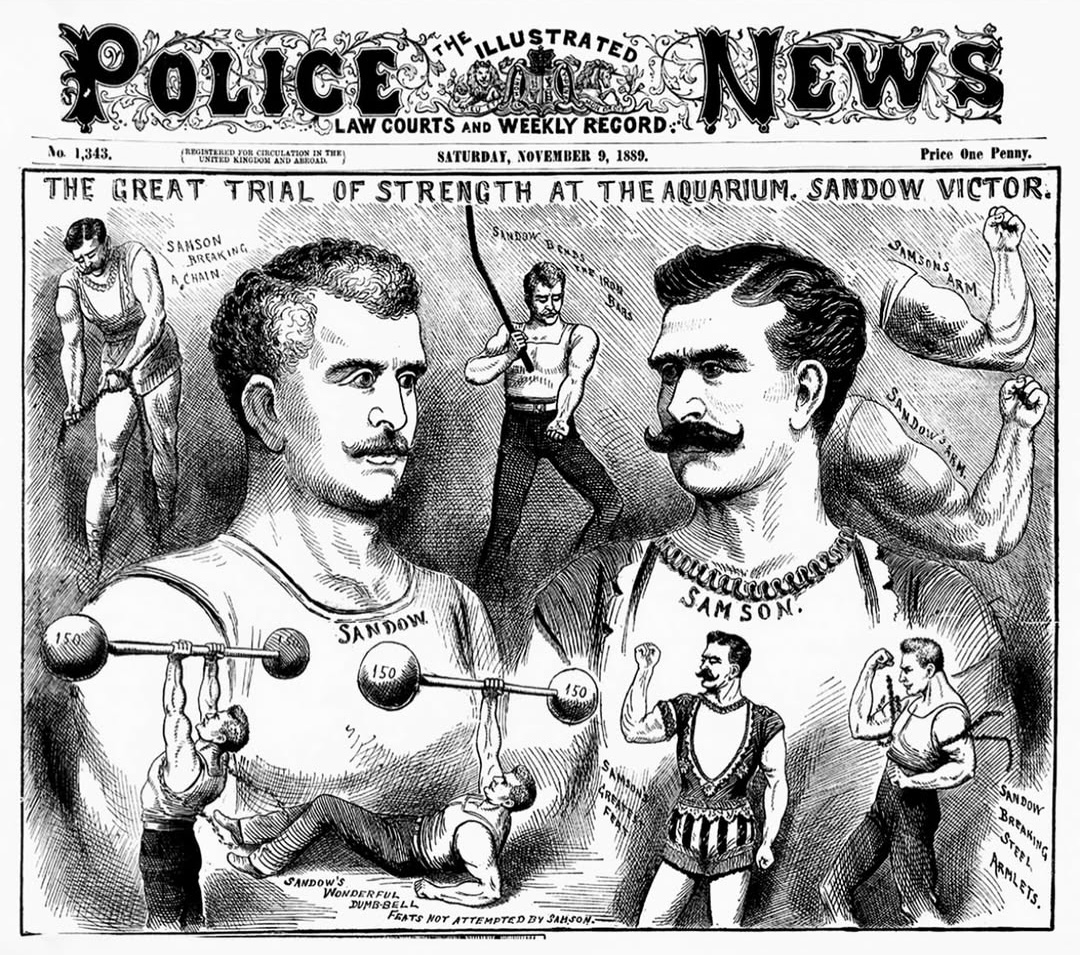
That line matters historically. Sandow did not merely survive the challenge; he redefined it. The decisive moment was not the chain-breaking or the bar bending. It was getting up.
More than a century later, the lesson remains. Real strength is not only the ability to lift a weight. It is the ability to own it—on the ground, in motion, and all the way back to standing.
If you are interested in a Hard Style dumbbell lifting program, please check out our Dumbbell Swing Tutorial [FREE VIDEO & MANUAL]

![Enter the Dumbbell! [ONLINE COURSE]](https://simplexstrong.com/wp-content/uploads/2025/12/strongfirst-enter-the-dumbbell-400x400.jpg)