![Eugene Sandow: Swing Ring-and-Ball Lift from the Ground Overhead [1894]](https://simplexstrong.com/wp-content/uploads/2017/04/eugene-sandow-kettlebell-swing-snatch-1080x630.png)
This is an effective as well as graceful exercise, calling into play the chief muscles of the trunk and limbs, and imparting litheness and elasticity to the movements.
The bell is placed on the floor a little in front of the feet, ring to the right, heels in line, and about ten inches apart.
![Siegmund Klein: The Kettle-bell [1932]](https://simplexstrong.com/wp-content/uploads/2017/03/siegmund-klein-kettlebell.jpg)
The “kettle-bell” has been for years a very important factor in developing strength, yet the modern weight-lifter rarely, if ever, uses it. This is partly the fault of the governing body of the International Weight-Lifting Association, for kettle-bells are not used in any contests under their auspices, hence contestants feel that it is useless to train with this “obsolete” article.
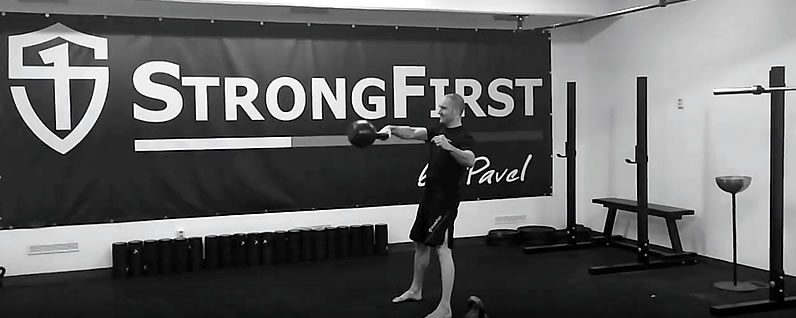
Most people do the swing wrong because they think it is a 2 count movement:
1 – down (= evading to soon, which leads to all kind of troubles like the weight pulling you forward, ending too low between the legs etc.)
2 – up (= lifting with the hands)
Think of the swing as 4 count movement (let’s start form the top):

Each training session of Hermann’s contained a mixed programme of kettlebell, dumb-bell and barbell lifting. Sometimes a workout would also include the supporting feats.
For instance, hen Hermann trained three times per week, he might in the first training session give preference to kettlebell exercises, but he would also include barbell and dumb-bell lifts too.


![Enter the Dumbbell! [ONLINE COURSE]](https://simplexstrong.com/wp-content/uploads/2025/12/strongfirst-enter-the-dumbbell-400x400.jpg)